Greenwood Colliery, Minooka

Greenwood Colliery, Minooka

Thursday, July 9, 2020

Michael Kelly, South Scranton Miner, Dies in Cave - January 1922


Three Men Entombed in the National Mine
Body of Michael Kelly Was Found by Rescue Party
at 11:15 o’clock Last Night - Large Area Affected
Thirty-five Men in that Part of Mine When Caving
Began Yesterday Morning - Many Had Narrow Escapes
Rescue Crews Working with Feverish Haste to
Reach Those Still Entombed

Three men were entombed, one man killed, three were injured, several others had miraculous escapes from death, and twenty acres of land were dropped in South Scranton in a squeeze of gigantic proportions in the Devil’s Eyebrow of Dunmore No. 2 vein of the National mine of the Glen Alden Coal Company yesterday morning.

Seventy-five men attacking the mass of debris, coal, rock and earth from three different angles had not reached the missing men up to an early hour this morning. W.W Inglis, President of the Glen Alden Company, is personally supervising the work of the rescuers, and it is hoped that the men will be found alive.

Michael Kelly of 2412 Winfield Avenue, a company hand, was killed. His body was found lying at a passing branch in the main gangway at 11:45 o’clock last night. A small scar on the head, probably received when he was thrown down by the force of the explosion, was the only mark on the dead miner’s body, according to reports from the rescuers.

With the exception of three entombed men, all other employees in the area affected by the cave had been accounted for, company officials said. The missing men are: Edgar Hughes, 1123 Ambers Street, Section foreman; Al Reese, 1014 Snyder Avenue, electrician and widely known sprinter and athlete; and John Barrett, 2106 Cedar Avenue, company hand.

Tuesday, June 2, 2020

Edward Gerrity Remembers Jimmy O'Neill and Minooka Blues


This is My Town by Edward J. Gerrity
Scranton Times
September 1976

This is a story that can appropriately be title, “The Last of the Blues”—the famed Minooka Blues, a baseball team organized in the very early 1900s that won acclaim nationwide for its smart and brilliant playing on its home field in Minooka and on lots faraway from home, too. It was a selected group of youths that was taught the diamond sport from A to Z, and in their first three seasons, there was not a single defeat marked on their outstanding record.

On last September 5, James O’Neill of Mercersburg, a former Minooka resident who had played shortstop for the Blues and whose diamond performances attracted a scout for the Washington Senators and later was signed for the start of a major-league career, died in Mercersburg. So far as can be ascertained, he was the last survivor of the great Minooka Blues.*

Jimmy came from a family of brothers who graduated from local sandlots to the major leagues in the early 1900s. Jimmy played two seasons with Washington in the early 1900s. Jimmy played two seasons with Washington in the American League in 1920 and 1923. His brother, Steve, who was the star catcher in his days with the Blues, signed with the Cleveland Indians as a maskman and was an outstanding fellow who handled all types of pitchers while at Cleveland from 1911 to 1928. Sports writers termed Steve as the best catcher in baseball at that time.

Anthony :"Tone" Walsh, Last of the Minooka Blues, Remembers

Anthony Walsh Remembers “Quick Moves”
Last of the Blues Still Active
By Bill Mang, Scranton Sunday Times Sports Writer

Anthony “Tone” Walsh certainly hasn’t contemplated stealing any bases in a good many years. As a matter of fact, his quickest moves now come when he takes his leisurely walk to church every Saturday evening.


Walsh, an 86-year-old lifelong Minooka resident, is the last living member of the legendary Minooka Blues. The Blues played baseball some 70 years ago at old Burke’s Field in Minooka. They were a neighborhood group of 12-15 year-olds, who made a habit of beating the stuffings out of teams composed of players twice their age.

The team included four players who went on to play in the major leagues, including Steve O’Neill, who caught for and later managed the Cleveland Indians and Detroit Tigers; Mike McNally, who was an infielder with the Boston Red Sox and New York Yankees; Jimmy O’Neill, who was a shortstop for the Washington Senators; and Charles Shorten, who became an outfielder with the Boston Red Sox.

Walsh, who was joined on the team by his brothers Mike and Pete, was the Blues’ second baseman.
And while the aging process has dulled the speed of the legs, his mind quickly recalls those enjoyable years from 1906-09 when he was helping the Blues win game after game.

Friday, May 1, 2020

1897 - Prelude to Strikes of 1900 and 1902 - Burke and Toole Testify - Terrence Powderly Visits Scranton


May 20, 1897 – Times-Tribune

Labor’s Ex-leader the First Witness
Hon. T. V. Powderly Before the Mine Commission Today
(Terrence Powderly was the former head of the Knights of Laborer (pre United Mine Workers union).

“Mr. Powderly was of the opinion that one of the chief causes of the present condition of the mining population was the improved machinery for the mining of coal, increasing the output, and at the same time, reducing the amount of labor. Another reason, which is rarely taken into consideration, was the gas stove, which is used to a surprising great extent in New York City and all throughout the Eastern cities.” (He also mentioned increased use of bicycles in the cities.)

“Powderly started that there has been a great deal of suffering among the miners of Scranton during the past winter by reason of their inability to secure work.

“Patrick B. Calpin of Bellevue, a laborer in the Oxford mine of the DL&W stated he was an inside laborer and got $2.20 per day for ten hours. He averaged ten or twelve days a month this year. His average pay per month has been $17 or $18. He cannot support his family as he desires on the amount of his wages. He testified that there is destitution and want among the miners of the vicinity.

Monday, April 20, 2020

Newspaper Stories from Old Minooka (1885-1886)


Old Minooka Stories (1885-1886)

Carr’s Patch – September 2, 1895 – Scranton Republican

“The most backward place for building or improvements is that part of Minooka known as Carr’s Patch. The Carr’s Patch of twenty years ago is the Carr’s Patch of today with very few exceptions. All the wanderer would miss to make it what it was then is the buildings and shanties owned and occupied that time by Dan O’Brien, whose death not long ago took place at the Hillside farm. It was thought that the bringing of the silk mill, steel mill and button factory close to it would wake it up, but it seems doomed to its present condition. Davis’ Patch, though springing into existence at about the same time, has miles of buildings, with thousands of inhabitants. These two places constitute what is known as Minooka. It has within its limits ten schools, one church, a large hall owned by the Father Mathew society, and six grocery and provision stores.”

Night School Opens – October 26, 1885 – Scranton Tribune

“The opening of night-schools in Lackawanna township is but another proof of the go-ahead spirit with which the School Board of the township is imbued. The sound of the large bell in Minooka every evening finds hundreds of boys whose good fortune it is to be in the district at their studies. Teachers should doubly exert themselves in behalf of those almost forgotten slate-pickers and drivers for no doubt on the teachers depend their future.”

Sunday, October 13, 2019

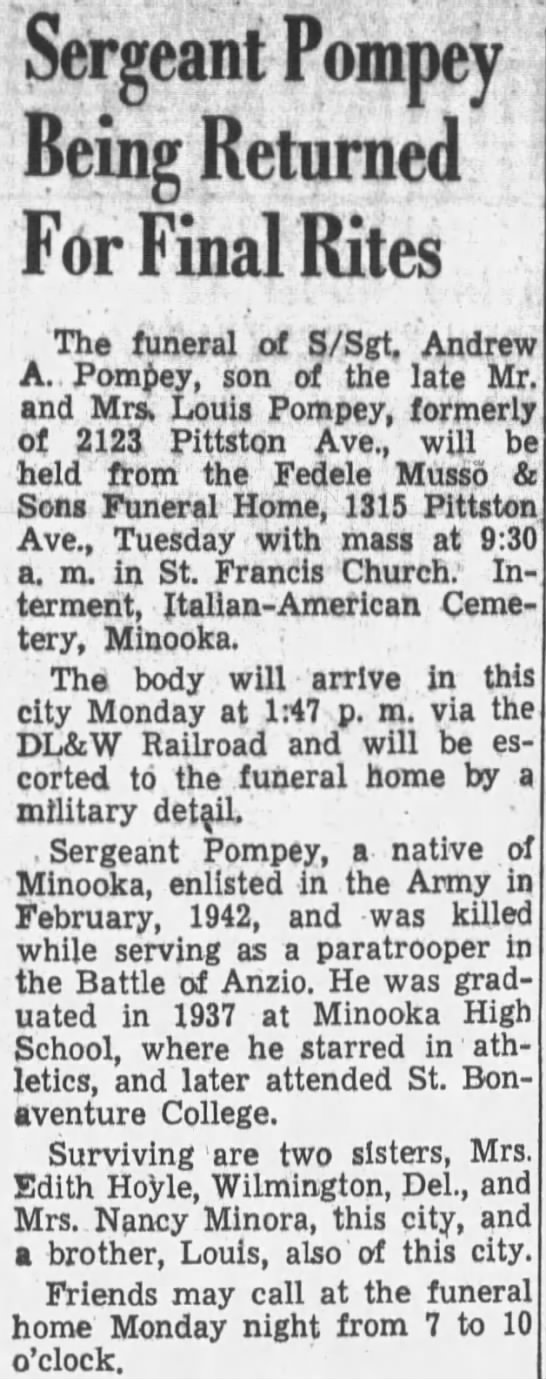
Sgt. John F. Buckley Dies in South Pacific - March 20, 1944


Pvt. Robert Ryan Killed In Luxembourg - February 17, 1945


Staff Sgt. Leo Burke - KIA in Middle East


March 8, 1944 - Times-Tribune

James O'Malley, USN, Ship Sunk off Salerno


September 23, 1943 - Times-Tribune

Henry Slavin - Dies of His Wounds in North Africa


March 20, 1944

Charles Stewart MIA over Bremen, Germany -


June 14, 1945 - Times-Tribune

According to Stewart's relations, his body was returned to Minooka, and he is buried in St. Joseph's Cemetery, Minooka.


Four Walsh Brothers Serve in WWII


Sunday, August 11, 2019

Saturday, August 10, 2019

Thomas "Tommy" Coyne Is Killed in Brittany - August 1944

Staff Sergeant Thomas "Tommy" Coyne was killed in Brittany in August 1944.


Coyne, who was born in 1917, was the son of Martin and Bridget Loretta Walsh Coyne, 2810 Pittston Avenue. A member of the 644th Tank Battalion, he was killed in action in Brittany, France on August 19, 1944. He was awarded the Silver Star and Purple Heart. Coyne is buried in the Brittany American Cemetery in Montjoie Saint Martin, France.


Thursday, August 8, 2019

Marshall Diskin at Home and Abroad


From Somewhere in England, where he has been serving with a unit of the U.S. Army Signal Corps for the past several months, Pvt. Marshall Diskin, son of Mr. and Mrs. P. J. Diskin of 2700 Birney Avenue, Minooka, forwarded these four interesting pictures.

Diskin and Sgt. McGuire of Boston viewing ruins of a large building, the target of a Nazi bomb before the RAF gained the upper hand; American boys unloading a light piece of army mobile equipment from a huge plane; Minooka soldier enjoying a little party with a group of his soldier companions (photo taken on visit to Ireland); Diskin chatting with a female bartender in a London pub.


Wednesday, February 21, 2018

Dr. Joe Lydon's Musings - Part 3

Minooka Musings – Part 2 – by Dr. Joseph Lydon (1922-2008) of the Sharkey Lydon Clan

Michael Lydon, Dr. Joe’s father, moved to Minooka in 1883 from Joyce Country. His wife was Mary Kerrigan of Upper Cloughbrack, Galway. These are Dr. Joe’s reminiscences.

“Apparently, there were a dozen or so of his [Mike Lydon’s] old Galway neighbors in town. I do not think there were any of my grandmother’s people in the area. Despite her illiteracy and lack of English, she did make a few friends, old ladies around the neighborhood who spoke Irish. (The Fahertys, my great grandparents were Irish speakers and lived two doors down.) They were known as “shawlies” as they were called for the black wool outer garments they seemed to wear in all seasons. From the time she landed in Minooka, until we buried her in 1928, I doubt my grandmother had ever been more than a few miles from her new home in this vast land.
“Back to “Daddeh” and “Maime,” as they were called by their children, which Gaelic corrupted into the “Daddy and Mommy” of the next generation.
“Anthracite is a coal like no other. It is practically pure carbon, sometimes brittle as glass and as shiny as diamonds. It gives off tremendous heat per weight and is almost smokeless in its burning.
“The breakers where the raw mine product was processed dotted the lower hills along the river, many of them giving rise to surrounding “patches” where the miners’ families lived, sometimes giving the name to what eventually became towns: Bellevue, Pine, Taylor, Greenwood, etc.
“The actual mining was a difficult, back-breaking, dangerous job with an injury and death rate second to none in the country. This is not to mention the longer-term effects of Black Lung disease as well as the sharply increased incidence of lung cancer. Accumulations of gas pockets did occur in Anthracite mining, they were not nearly so common as in the soft-coal fields. The specific geology, peculiar to the hard-coal fields, made the “fall of roof” the biggest hazard. It took a certain amount of training before a man could get his “mining papers,” which certified him to be a real contract miner responsible for the laborer who worked along with him. Compared with bituminous mining, the anthracite miner was a skilled tradesman. It was also more dangerous.
“My grandfather bought three lots on the northeast corner of Davis Street and Pittston Avenue which gave him a ringside view of all funeral processions. He was one of the town’s leading funeral marchers. I can still picture him, Mikey Faherty, Pat Mullen, Tom Kelly, Wet Joyce, and a few other regulars in the same black hats, “Connie Mack” white collars, black suits, vests, and watch chains pumping their shiny shoes up what we called “Symmetry Hill,” in their procession from the church to the graveyard. The latter was on a low ridge to the east that paralleled the town. Coincidentally or not, this ridge contained six or seven denominational or ethnically different peoples: a large Polish cemetery (Sacred Heart), a Russian Orthodox, an Italian, a German, and a much larger Polish National.”
Michael Lydon’s brother John emigrated at the same time as his brother and lived in Hyde Park.

Dr. Joe Lydon's Musings - Part 2

Well God Bless All You Sentimental
Choristers of the Old Days

1920s

I suppose if the Negroes can have their spirituals and the Jews their holy chants of Egyptian bondage, I suppose we can have title to a few that helped us through our days of captivity in Minooka where we spent so many happy years successfully disguised as “poor people.”

This is by no means a complete list of treasured ditties. Mine is just a gathering of sound and memory that covers the years between 1925 and 1932. I am sure each of us has a recollection of similar tunes that have equal degrees of poignancy and schlock, such as “The Day Poor Benny Died” and “The Baggage Coach Ahead.”

Then there were the great ones from the Biggie—WWII! “I’ll Be Seeing You” may be the best. “Now Is The Hour,” Lili Marlene,” … many more … some sensored for tender ears.

Charley Lydon, Aunt Katie’s   (Hefferen)son, who bought the farm at Chateau Thierry in 1918, Lavina’s favorite – “Meet Me Tonight in Dreamland”

How about the one Pat Gibbons always sang to Kathleen Donnelly back in their courting days: “Wonderful One.”

When, as a boy, I would go to town with Lavina, we always ate at the best… Kresge’s or Woolworth’s counter… the best root beer and hot dogs ever made!


On Taylor pay nights in the winter, Sharkey would take me or Jack to the Vaudeville show at the old Capitol. He would fold his overcoat under me so I would not miss a thing. It was all very tame despite such billings as “Sophie Tucker, The Last of the Red Hot Mamas!” Sophie was an aging Yenta at this point who moved around somewhat like Queenie the elephant. There was always a kid act or two, a dog that did tricks and a clown with baggy pants—the whole schtik!

Thursday, January 11, 2018

A Murderer's County - An Update on Minooka Connections

When I published A Murderer’s Country, I knew of one connection to Minooka with the regard to the murders of bailiff Joseph Huddy and his grandson on January 3, 1882 in Upper Cloughbrack, Galway: Sharkey Lydon’s grandmother, Mary Kerrigan Lydon, had witnessed the murders, and Mary’s father, Mathias Kerrigan, had testified for the prosecution. Before turning Queen's evidence, Mathias had been detained, without charge, for nine months because the murders had been committed in his yard. It was Mathias who had named the three men found guilty of the murders.
After the trials, Mary married Michael Lydon in Dooras (we think) in 1883. After immigrating to America, they built a house in the 3000 block of Pittston Avenue. Sharkey and Dr. Joe Lydon lived in the same house as their Irish-speaking grandmother until her death in 1928. The Huddy murders were a part of family lore. As it turns out, Mary is not the only Minooka connection.
Three men were convicted and executed for the Huddy murders: Michael Flynn and Thomas Higgins of Middle Cloughbrack, also known as America, and Patrick Higgins of Upper Cloughbrack, an adjacent village. Patrick Higgins was first cousin to Bridget Kerrigan Kerrigan, Mathias’s wife and Mary’s mother, and, therefore, related to the Sharkey Lydons.
The investigation into the Huddy murders was conducted between January and September, 1882. During that time, 211 people were questioned. One of those interviewed was Julia “Judy” Higgins Holleran, the sister of Thomas Higgins. She stated that she had been at her brother’s house on the day of the murders and that he had not been out of her sight for longer than fifteen minutes; that is, not enough time to kill the Huddys. At the trial of Thomas Higgins, her testimony was vigorously challenged by the prosecution, and the jurors did not believe her.
Julia Higgins had married Michael Holleran from Glenlusk in 1874. Their daughter, Bridgit Holleran, moved to Minooka and married Thomas F. Kearney and lived at 2707 Cedar Avenue where they raised twelve children.
Michael Flynn’s widow, Bridgit Higgins, was the sister of Thomas Higgins. A few years after his execution, Bridgit and at least six of her seven children moved to Minooka. Most of their children moved on to Pittsburgh and Ohio, but Catherine and Michael stayed in Minooka. Catherine married Patrick Laffey, son of James Laffey and Peggy Mulroe. In 1920, the Laffeys lived at 2901 Cedar Avenue. Michael married Mary Coyne, and in 1920, lived at 2718 Colliery Avenue. They had at least five children. Tragically, Bridgit Higgins Flynn was killed by a train in 1911. She and her daughter Catherine “Kate” Laffey had visited friends in Taylor. On the way home, they had been caught in a heavy rainstorm, and Bridget sought shelter under a train. When the car started to move, she was killed in front of Kate.

In summary, all three men who were found guilty of the Huddy murders have direct connections to Minooka. The book is available in paperback and on Kindle. See the links below.