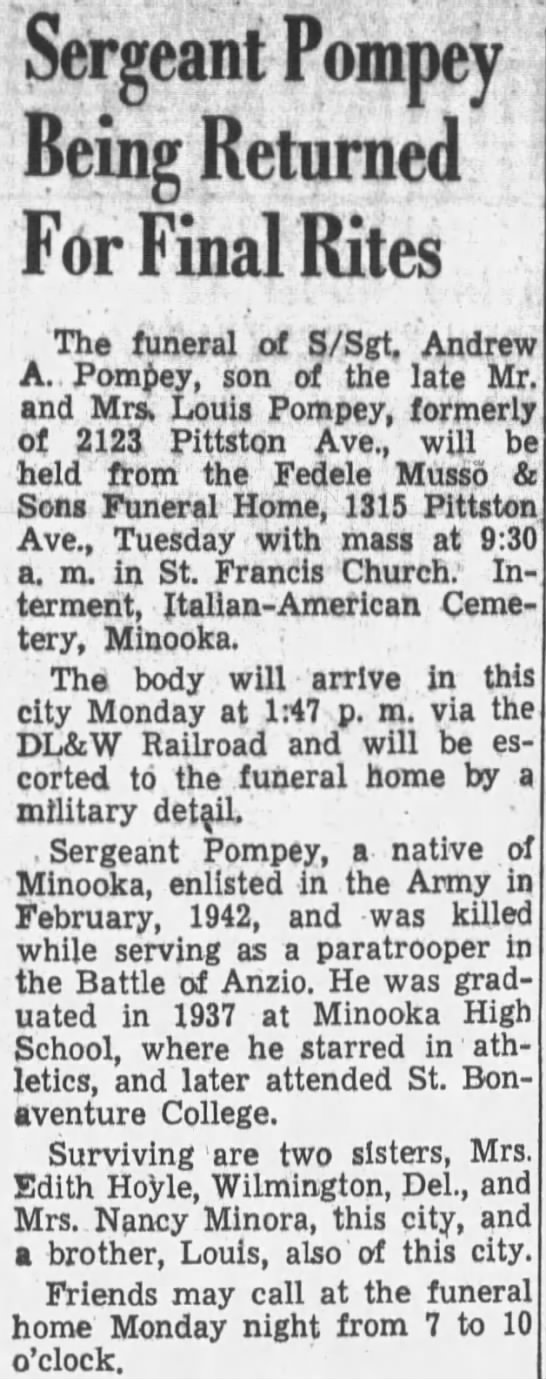
The Pompeys lived at 2123 Pittston Avenue.
Greenwood Colliery, Minooka
Sunday, August 11, 2019
Andrew Pompey KIA at Anzio; Brother Durando KIA in France
Saturday, August 10, 2019
Thomas "Tommy" Coyne Is Killed in Brittany - August 1944
Staff Sergeant Thomas "Tommy" Coyne was killed in Brittany in August 1944.
Coyne, who was born in 1917, was the son of Martin and Bridget Loretta Walsh Coyne, 2810 Pittston Avenue. A member of the 644th Tank Battalion, he was killed in action in Brittany, France on August 19, 1944. He was awarded the Silver Star and Purple Heart. Coyne is buried in the Brittany American Cemetery in Montjoie Saint Martin, France.
Thursday, August 8, 2019
Marshall Diskin at Home and Abroad
From Somewhere in England, where he has been serving with a unit of the U.S. Army Signal Corps for the past several months, Pvt. Marshall Diskin, son of Mr. and Mrs. P. J. Diskin of 2700 Birney Avenue, Minooka, forwarded these four interesting pictures.
Diskin and Sgt. McGuire of Boston viewing ruins of a large building, the target of a Nazi bomb before the RAF gained the upper hand; American boys unloading a light piece of army mobile equipment from a huge plane; Minooka soldier enjoying a little party with a group of his soldier companions (photo taken on visit to Ireland); Diskin chatting with a female bartender in a London pub.
Wednesday, February 21, 2018
Dr. Joe Lydon's Musings - Part 3
Minooka Musings – Part 2 – by Dr. Joseph Lydon (1922-2008) of the Sharkey Lydon Clan
Michael
Lydon, Dr. Joe’s father, moved to Minooka in 1883 from Joyce Country. His wife
was Mary Kerrigan of Upper Cloughbrack, Galway. These are Dr. Joe’s
reminiscences.
“Apparently,
there were a dozen or so of his [Mike Lydon’s] old Galway neighbors in town. I
do not think there were any of my grandmother’s people in the area. Despite her
illiteracy and lack of English, she did make a few friends, old ladies around
the neighborhood who spoke Irish. (The Fahertys, my great grandparents were
Irish speakers and lived two doors down.) They were known as “shawlies” as they
were called for the black wool outer garments they seemed to wear in all
seasons. From the time she landed in Minooka, until we buried her in 1928, I
doubt my grandmother had ever been more than a few miles from her new home in
this vast land.
“Back to
“Daddeh” and “Maime,” as they were called by their children, which Gaelic
corrupted into the “Daddy and Mommy” of the next generation.
“Anthracite
is a coal like no other. It is practically pure carbon, sometimes brittle as
glass and as shiny as diamonds. It gives off tremendous heat per weight and is
almost smokeless in its burning.
“The breakers
where the raw mine product was processed dotted the lower hills along the
river, many of them giving rise to surrounding “patches” where the miners’
families lived, sometimes giving the name to what eventually became towns:
Bellevue, Pine, Taylor, Greenwood, etc.
“The
actual mining was a difficult, back-breaking, dangerous job with an injury and
death rate second to none in the country. This is not to mention the
longer-term effects of Black Lung disease as well as the sharply increased
incidence of lung cancer. Accumulations of gas pockets did occur in Anthracite
mining, they were not nearly so common as in the soft-coal fields. The specific
geology, peculiar to the hard-coal fields, made the “fall of roof” the biggest
hazard. It took a certain amount of training before a man could get his “mining
papers,” which certified him to be a real contract miner responsible for the
laborer who worked along with him. Compared with bituminous mining, the
anthracite miner was a skilled tradesman. It was also more dangerous.
“My grandfather
bought three lots on the northeast corner of Davis Street and Pittston Avenue
which gave him a ringside view of all funeral processions. He was one of the
town’s leading funeral marchers. I can still picture him, Mikey Faherty, Pat
Mullen, Tom Kelly, Wet Joyce, and a few other regulars in the same black hats,
“Connie Mack” white collars, black suits, vests, and watch chains pumping their
shiny shoes up what we called “Symmetry Hill,” in their procession from the
church to the graveyard. The latter was on a low ridge to the east that
paralleled the town. Coincidentally or not, this ridge contained six or seven
denominational or ethnically different peoples: a large Polish cemetery (Sacred
Heart), a Russian Orthodox, an Italian, a German, and a much larger Polish
National.”
Michael
Lydon’s brother John emigrated at the same time as his brother and lived in
Hyde Park.
Dr. Joe Lydon's Musings - Part 2
Well God Bless All You Sentimental
Choristers of the Old Days
1920s
I suppose if the Negroes can have their spirituals and the
Jews their holy chants of Egyptian bondage, I suppose we can have title to a
few that helped us through our days of captivity in Minooka where we spent so
many happy years successfully disguised as “poor people.”
This is by no means a complete list of treasured ditties.
Mine is just a gathering of sound and memory that covers the years between 1925
and 1932. I am sure each of us has a recollection of similar tunes that have
equal degrees of poignancy and schlock, such as “The Day Poor Benny Died” and
“The Baggage Coach Ahead.”
Then there were the great ones from the Biggie—WWII! “I’ll
Be Seeing You” may be the best. “Now Is The Hour,” Lili Marlene,” … many more …
some sensored for tender ears.
Charley Lydon, Aunt Katie’s (Hefferen)son, who bought the farm at
Chateau Thierry in 1918, Lavina’s favorite – “Meet Me Tonight in Dreamland”
How about the one Pat Gibbons always sang to Kathleen Donnelly
back in their courting days: “Wonderful One.”
When, as a boy, I would go to town with Lavina, we always
ate at the best… Kresge’s or Woolworth’s counter… the best root beer and hot
dogs ever made!
On Taylor pay nights in the winter, Sharkey would take me or
Jack to the Vaudeville show at the old Capitol. He would fold his overcoat
under me so I would not miss a thing. It was all very tame despite such
billings as “Sophie Tucker, The Last of the Red Hot Mamas!” Sophie was an aging
Yenta at this point who moved around somewhat like Queenie the elephant. There
was always a kid act or two, a dog that did tricks and a clown with baggy
pants—the whole schtik!
Labels:
Donnelly,
Gibbons,
Hefferen,
Sharkey Lydon,
Songs
Thursday, January 11, 2018
A Murderer's County - An Update on Minooka Connections
When I published A Murderer’s Country, I knew of one
connection to Minooka with the regard to the murders of bailiff Joseph Huddy
and his grandson on January 3, 1882 in Upper Cloughbrack, Galway: Sharkey Lydon’s grandmother, Mary Kerrigan
Lydon, had witnessed the murders, and Mary’s father, Mathias Kerrigan, had testified for the prosecution. Before turning Queen's evidence, Mathias had been
detained, without charge, for nine months because the murders had been
committed in his yard. It was Mathias who had named the three men found guilty of the murders.
After the
trials, Mary married Michael Lydon in Dooras (we think) in 1883. After
immigrating to America, they built a house in the 3000 block of Pittston
Avenue. Sharkey and Dr. Joe Lydon lived in the same house as their
Irish-speaking grandmother until her death in 1928. The Huddy murders were a
part of family lore. As it turns out, Mary is not the only Minooka connection.
Three men
were convicted and executed for the Huddy murders: Michael Flynn and Thomas
Higgins of Middle Cloughbrack, also known as America, and Patrick Higgins of
Upper Cloughbrack, an adjacent village. Patrick Higgins was first cousin to
Bridget Kerrigan Kerrigan, Mathias’s wife and Mary’s mother, and, therefore,
related to the Sharkey Lydons.
The
investigation into the Huddy murders was conducted between January and
September, 1882. During that time, 211 people were questioned. One of those
interviewed was Julia “Judy” Higgins Holleran, the sister of Thomas Higgins.
She stated that she had been at her brother’s house on the day of the murders
and that he had not been out of her sight for longer than fifteen minutes; that
is, not enough time to kill the Huddys. At the trial of Thomas Higgins, her
testimony was vigorously challenged by the prosecution, and the jurors did not
believe her.
Julia
Higgins had married Michael Holleran from Glenlusk in 1874. Their daughter,
Bridgit Holleran, moved to Minooka and married Thomas F. Kearney and lived at
2707 Cedar Avenue where they raised twelve children.
Michael
Flynn’s widow, Bridgit Higgins, was the sister of Thomas Higgins. A few years
after his execution, Bridgit and at least six of her seven children moved to
Minooka. Most of their children moved on to Pittsburgh and Ohio, but Catherine
and Michael stayed in Minooka. Catherine married Patrick Laffey, son of James
Laffey and Peggy Mulroe. In 1920, the Laffeys lived at 2901 Cedar Avenue.
Michael married Mary Coyne, and in 1920, lived at 2718 Colliery Avenue. They
had at least five children. Tragically, Bridgit Higgins Flynn was killed by a train
in 1911. She and her daughter Catherine “Kate” Laffey had visited friends in
Taylor. On the way home, they had been caught in a heavy rainstorm, and Bridget
sought shelter under a train. When the car started to move, she was killed in
front of Kate.
In
summary, all three men who were found guilty of the Huddy murders have direct
connections to Minooka. The book is available in paperback and on Kindle. See the links below.
Friday, October 27, 2017
New Release - A Murderer's Country, Joyce Country, Galway during Ireland's Land War - 1879-1882
Available from Amazon in paperback and on Kindle.
My book, A Murderer’s Country, Joyce Country, Galway, during Ireland’s Land War, looks at a number of murders that took place in the West of Ireland, beginning with the assassination of the Earl of Leitrim in 1879. Leitrim’s murder was a harbinger of the violence that would descend on Galway during the Land War of 1879-1882.
As I stated in the book, this is an on-going project, and in the months since it was first released, I have made a number of changes, most of which are a result of descendants of those involved contacting me. Here are a few updates:
Correction: The prosecution presented its case first, not the defense.
Correction: At the sentencing of Patrick Higgins, Justice O'Brien did not don the black cap. In doing so, he signaled to defense that they should petition the Lord Lieutenant for mercy, a petition that was denied.
Update: Bridget Higgins Flynn, the widow of Michael Flynn, who was convicted of the Huddy murders, moved to Minooka in 1887 with her six sons and one daughter. Daughter Catherine ("Kate") married Patrick Laffey, son of James Laffey and Margaret "Peggy" Mulroe, and died in 1959. Michael Flynn, Jr. married Mary Coyne and died in South Scranton in 1952. The other five Flynn children moved out of Minooka. Thomas Flynn settled in Youngstown, Ohio. I do not know what happened to the other four Flynn sons. Tragically, Bridget Higgins Flynn was killed in 1911 after sheltering from the rain under a freight car. When the train began to move, she was crushed in view of her daughter Kate.
Update: Thomas Higgins, who was convicted of the Huddy murders, was the brother of Bridget Higgins, wife of Michael Flynn. The two brothers-in-law conspired to kill bailiff Joseph Huddy.
Update: Patrick Sweeney, the herd for Lord Ardiluan, died in Galway sometime between 1901-1904. His son Patrick immigrated to Pittsburgh.
My book, A Murderer’s Country, Joyce Country, Galway, during Ireland’s Land War, looks at a number of murders that took place in the West of Ireland, beginning with the assassination of the Earl of Leitrim in 1879. Leitrim’s murder was a harbinger of the violence that would descend on Galway during the Land War of 1879-1882.
As I stated in the book, this is an on-going project, and in the months since it was first released, I have made a number of changes, most of which are a result of descendants of those involved contacting me. Here are a few updates:
Correction: The prosecution presented its case first, not the defense.
Correction: At the sentencing of Patrick Higgins, Justice O'Brien did not don the black cap. In doing so, he signaled to defense that they should petition the Lord Lieutenant for mercy, a petition that was denied.
Update: Bridget Higgins Flynn, the widow of Michael Flynn, who was convicted of the Huddy murders, moved to Minooka in 1887 with her six sons and one daughter. Daughter Catherine ("Kate") married Patrick Laffey, son of James Laffey and Margaret "Peggy" Mulroe, and died in 1959. Michael Flynn, Jr. married Mary Coyne and died in South Scranton in 1952. The other five Flynn children moved out of Minooka. Thomas Flynn settled in Youngstown, Ohio. I do not know what happened to the other four Flynn sons. Tragically, Bridget Higgins Flynn was killed in 1911 after sheltering from the rain under a freight car. When the train began to move, she was crushed in view of her daughter Kate.
Update: Thomas Higgins, who was convicted of the Huddy murders, was the brother of Bridget Higgins, wife of Michael Flynn. The two brothers-in-law conspired to kill bailiff Joseph Huddy.
Update: Patrick Sweeney, the herd for Lord Ardiluan, died in Galway sometime between 1901-1904. His son Patrick immigrated to Pittsburgh.
The
Murder of William Sydney Clements, 3rd Earl of Leitrim
Family
Names: Fitzhenry, Joyce, Holleran, O’Neill, Spellman, Walsh
Locations: Milford, Donegal; Fanad Peninsula, Donegal; Maam Valley and Joyce Country, Galway
![]() |
| William Sydney Clements, 3rd Earl of Leitrim |
If
anyone made a case for the advancement of tenant rights in Ireland in the second half of the 19th century,
it was the 3rd Earl of Leitrim, possibly the
worst landlord in Ireland. Before the 1870 Land Act, an act that
provided some tenant relief, those farmers who held their leases from Leitrim
were without protection of any kind and subject to eviction with little notice.
In order to keep his tenants in a perpetual state of unease, every eleven
months, Leitrim’s tenants were served with notices to quit before new leases
were signed.
When
approached by a tenant to appeal an eviction, Leitrim’s favorite phrase was:
“Go to hell or America.” This was a problem for many of our ancestors as
Leitrim owned vast properties in Galway, including the Maam Valley, parts of
the Rosshill estate near Clonbur, Claggan, Glenlusk, Boocaun, and Rusheen, to
name a few. Shortly before his murder, Leitrim had signaled to his Galway
tenants that it was his intention to “cast a rod on Lough Mask,” and while he
was fishing, his bailiffs would be “evicting twenty tenants in the Maam
Valley.” It is possible that Michael
O’Neill, the father of the O’Neill brothers of baseball fame, was one of
those tenants who was evicted by Leitrim’s successor as Michael left the Maam
Valley in 1879 for Minooka. His family followed in 1880. It may be why my
great-grandmother, Bridgit Walsh Lydon,
went to America as well as her brother Richard
Walsh and sister Mary Walsh Lydon,
all settling in Minooka.
There was another reason for the exodus
to Minooka. Between 1878 and 1880, a mini-famine struck Galway, and with fears
of a recurrence of the Great Hunger, many chose to leave Galway forever. For
those who stayed behind, there was real resentment that “landlordism” had
resulted in emigration and starvation, and there were those who decided that
violence was the only thing that would bring about change.
*
* *
Murder of William Browne
Montmorency, Lord Mountmorres
Family Names: Burke, Corbett,
Fallon, Hennelly, Kearney, Mulroe, Murphy, Sweeney
Locations: Ebor Hall; Dooroy and Clonbur, Galway; Cong, Mayo
![]() |
| Lord Mountmorres |
The
second murder was that of William Browne Montmorency, Lord Mountmorres, who was
assassinated near his home, Ebor Hall, near Dooroy on September 25, 1880.
Mountmorres owned 300 acres near Tumneenaun Bay on the shores of Lough Corrib.
His crime was not so much that he was a bad landlord—he only had ten
tenants—but that he was a spy for the British Government and that he reported on
Land League activities in the Clonbur area. The murder was planned at the
publichouse of Patrick Kearney in the village of Clonbur and
executed on the road between Clonbur, where Mountmorres had spent the evening
in his role as magistrate, and Ebor Hall.
*
* *
Bailiff Joseph Huddy and his grandson, John Huddy
Family Names: Comer,
Conroy, Coyne, Flynn, Higgins, Holleran, Joyce, Kerrigan, Laffey, Sharkey
Lydon, Macken, Mannion, Moran, Mulroe, Walsh
Locations: Upper and Middle (America) Cloughbrack; Crumlin; Claggan
![]() |
| Arthur Guinness, 1st Lord Ardilaun |
On
the morning of January 3, 1882, Joseph Huddy, bailiff for Arthur Guinness, the
1st Lord Ardilaun, and his grandson, went to the villages of Upper
and Middle Cloughbrack on the shores of Lough Mask to serve eviction notices to
twelve families. Two men, Michael Flynn and Thomas Higgins, followed the
process servers into the yard of Mathias (Matthew) Kerrigan in Upper
Cloughbrack. The elder Huddy was killed in Kerrigan’s yard, and the boy was
pursued down a lane (called a boreen) and murdered. Their bodies were then thrown
into Lough Mask. (The death of the Huddys became known as the “Lough Mask
Murders.”). After a search of the surrounding area, a crew from the HMS Banterer dragged the lake, and three
weeks after their murders, the bodies were recovered. In addition to Michael
Flynn and Thomas Higgins, Patrick Higgins (Long) was charged with the Huddy
murders, and Patrick Higgins (Sarah) was charged with being an accessory. A
witness to the murders was Mathias Kerrigan’s daughter, Mary Kerrigan, who was
the grandmother of Sharkey Lydon.
![]() |
| Police Hut housing Royal Irish Constabulary |
![]() |
| Mathias Kerrigan and wife, Bridgit Kerrigan |
These murders had a tremendous impact on all of Joyce Country. For ten months, police and Crown investigators interviewed and re-interviewed as many as 211 people, including children, in their efforts to find the murderers of the bailiff and his grandson. Due to a threat of further violence, a police hut was erected in Middle Cloughbrack (also known as America because so many people had emigrated to the States from the village). In order to protect witness Mathias Kerrigan (Sharkey Lydon’s great-grandfather), a second police hut was erected in Kerrigan’s yard and would remain there until his death in 1898.
![]() |
| Greenstreet Courthouse, Dublin Site of Four Huddy Murder Trials |
*
* *
Murders of John
Joyce; Bridgit Casey O’Brien Joyce, John’s wife; Margaret, John’s mother; Peggy,
a daughter from John’s first marriage; and Michael, John’s son.
Families Names:
Casey, , Cusick, Joyce, Philbin
Locations: Maamtrasna, Cappanachrea, and Bunachrick, Galway; Tourmakeady (Cappaduff) Mayo
On
August 18, 1882, in the mountains of Maamtrasna, north of Lough Mask, five
members of the John Joyce family were murdered in their home. Although attempts
were made by the British government to tie the murders to the Land League,
these killings were tribal rather than political. John Joyce, a known sheep
thief, and his family, were victims of angry neighbors who wanted to be rid of
a man who stole anything he set eyes on. The murders were particularly savage,
and for many, confirmed that Ireland had become ungovernable.
In
an act of revenge, three members of another Joyce family from a nearby village
made up a story entirely out of whole cloth about witnessing the actual
murders. Of the ten men named by the fabricating Joyces, only two were actually
guilty of the crime, and their participation in the murders had been a matter
of guesswork on the part of their accusers.
![]() |
| Myles Joyce, Executed; Tom Casey, Informer |
As a result of the false testimony of
the Joyce informers, two men, who had nothing to do with the murders, turned
Queen’s evidence, naming five innocent men as participating in the murders. The
names had been fed to the informers during their interrogations by Crown Prosecutor
George Bolton. Four of those men, after pleading guilty on the advice of their
priest, were found guilty of murder and were given sentences of twenty years of
hard labor, and the fifth, Myles Joyce of Cappanachrea, was hanged, protesting
his innocence with his last breath. The actual killers, members of the clan of
Big John Casey of Bunachrick, went free.
As
a result of these murders, the area between Lough Mask and Lough Corrib, aka
Joyce Country, became known as a Murderer’s Country.
If
anyone has any information on any of these murders, I can be contacted at
quailcreekpub@hotmail.com.
A
Murderer’s Country is available on Kindle and in paperback from Amazon. I would
suggest the paperback because of notes and footnotes, and there’s a bonus: more
pictures.
Labels:
A Murderer's Country,
Huddy Murders,
Ireland,
Joyce Country,
Land War,
Lord Leitrim,
Lord Mountmorres,
Lough Mask Murders,
Maamtrasna,
Mary Kerrigan Lydon,
Michael Flynn,
Patrick Higgins,
Thomas Higgins
Subscribe to:
Posts (Atom)